

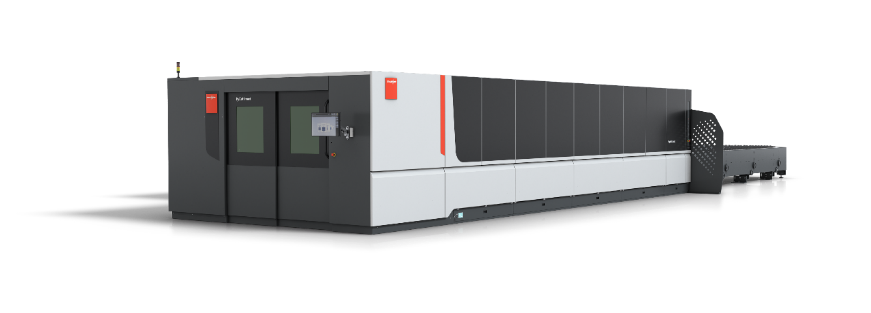
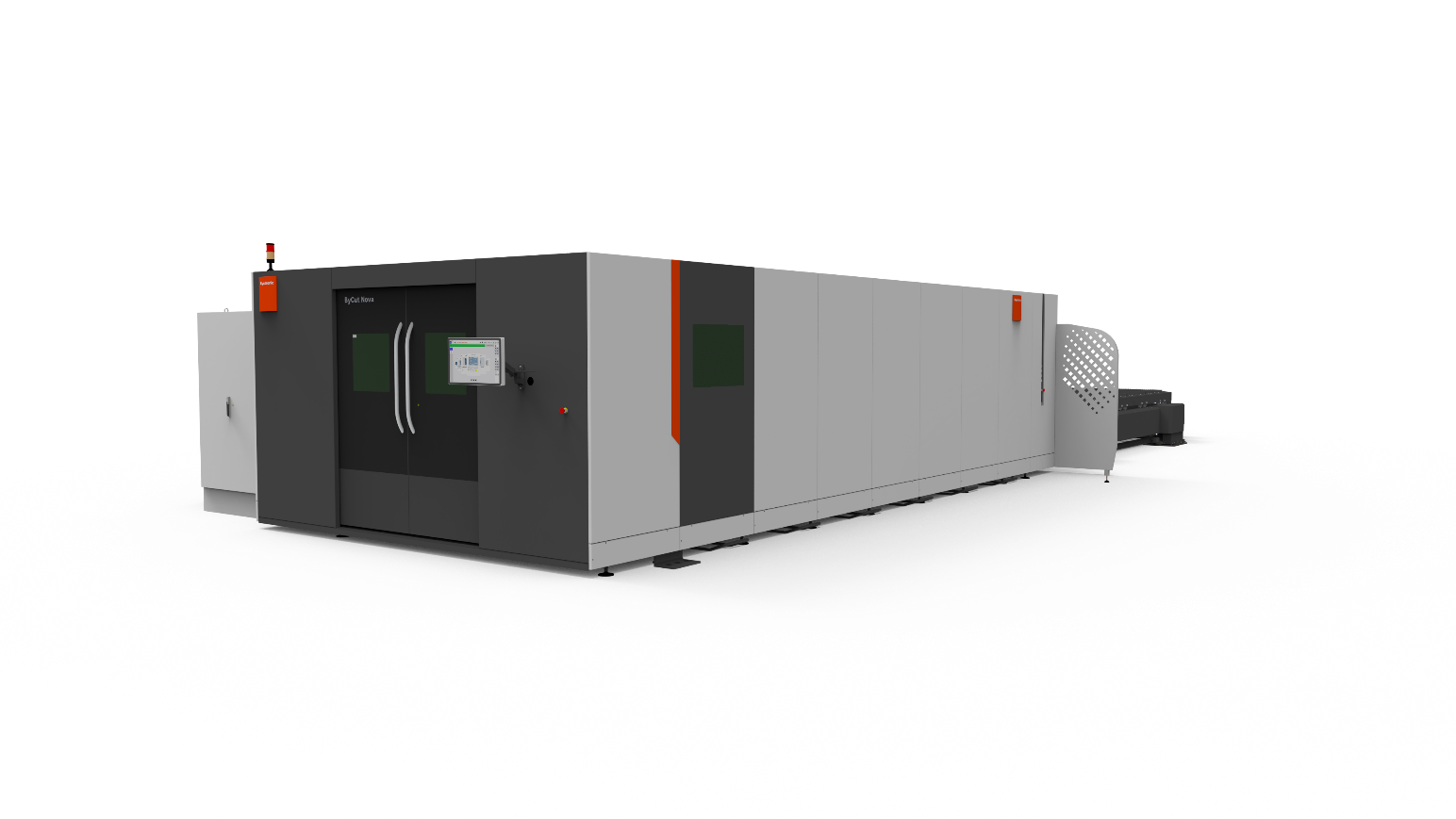
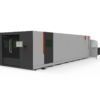
Bystronic ByCut Nova laser cutting machine
| Technical data | Specification |
|---|---|
| Average bilateral position deviation of one axis M (following ISO 230-2:2014) | 0.1 mm |
| Nominal sheet size (X, Y) | 3,000 × 1,500 mm |
| Stainless steel (max. cutting sheet thickness) | 30 mm |
| Height, approx. [H], w/o dust extraction | 2,620 mm |
| Laser source | Fiber 12 kW |
| Power | 12 kW |
| Max. workpiece weight | 1,400 kg |
| Length, approx. [L] | 9,500 mm |
| Max. positioning speed parallel axis X/Y | 100 m/min |
| Wavelength | Fiber |
| Total power consumption of the system (incl. exhaust and chiller) | ≤22 kW |
| Max. positioning speed simultaneous | 140 m/min |
| Edge detection accuracy (±) | 1 mm |
| Range of adjustment | 1.2–12 kW |
| Cutting area (X/Y/Z) | 3,050 × 1,550 × 100 mm |
| Bilateral repeatability of positioning of one axis R (following ISO 230-2:2014(E)) | 0.05 mm |
| Width, approx. [W] | 5,900 mm |
The Bystronic ByCut Nova fiber laser cutting machine is a series of devices developed to provide stable processing efficiency, convenient operation, and cutting quality that meets the needs of industrial production. It is suitable for businesses that need to process various types of sheet metal parts in different quantities and with varying technical requirements, from small orders to large-scale production.
Thanks to the application of fiber laser technology, the ByCut Nova can perform fast, precise cuts and minimize thermal deformation on the material. The machine is suitable for processing carbon steel, stainless steel, aluminum, and other metal materials according to the selected configuration. The control system supports cutting program management, part placement on the sheet, and monitoring the processing process, making it easier for operators to control production.
The enclosed machine chamber design contributes to enhanced safety and maintains a clean working environment. The ByCut Nova is suitable for mechanical factories, equipment manufacturing, electrical panel production, steel structures, and industrial components. When integrated with additional workpiece feeding, unloading, or material storage systems, the machine can form an automated processing line, reducing preparation time and improving overall efficiency.

Related products

Bystronic ByStar fiber laser cutting machine

Bystronic BySmart Fiber laser cutting machine

Cutting Machine MPS Series